
Many facilities already have meters, probes, and measuring equipment installed. The data exists, but it is not always transformed into concrete decisions: power adjustments, schedule changes, leak detection, fairer distributions, or investments that truly save.
The key is not only to measure, but to connect the data with the decision.
What role do measurement, data acquisition, software, and panel design play in energy decision-making?
If you already have meters installed and feel that you are “not getting the most out of them”, we can help you make that leap. Tell us about your case
From kWh to context: why raw data is not enough
A meter can tell us that 2,500 kWh have been consumed in a period.
The important question is not “how much?”, but:
- Is it a lot or a little for this building, this line, or this process?
- What happened to make it go up or down?
- At what time of day or week does consumption spike?
- What can we do to correct it?
Without context, the data is just a number.
Without structure, the data is lost in loose files.
Without visualization, the data does not reach the person who has to decide.
That is why the objective of an intelligent measurement system is not to accumulate data, but to convert it into actionable information.
Do you find it difficult to interpret the reports you receive from your meters?
Request a demo of our platform
USANCA Technology: software and hardware
Step 1: measure well – meters and probes in the right place
The process begins at the most physical point: what we measure and where.
In a typical installation, the following may coexist:
- Thermal energy meters (heating, cooling, district heating/cooling).
- Water meters (cold, DHW, processes).
- General and partial electrical meters.
- Cost allocators on radiators.
- Probes for temperature, humidity, pressure, or luminosity.
Key decisions in this phase:
- Define relevant measurement points: not only the general meter, but also critical zones, lines, users, or processes.
- Differentiate between fixed and variable consumption.
- Associate each measurement point with a clear unit of analysis: dwelling, premises, production line, building, etc.
The better this measurement layer is designed, the easier the next step will be: interpret what is happening.
Step 2: from the field to the server – acquire, concentrate, and send data
The second step is to take that data from the meter to the management platform without losing quality or reliability.
This is where the communication architecture comes into play:
- WMBus/OMS radio networks in buildings where wiring is difficult.
- Wired M-Bus networks, more classic but very robust.
- Industrial protocols such as Modbus or KNX in complex installations.
- Elements such as concentrators, repeaters, and control units that organize data traffic.
In a system like Usanca’s, for example, the typical flow would be:
- Meters and probes send their data via cable or radio.
- Radio repeaters extend coverage in difficult areas (basements, patios, installation rooms, etc.).
- A multi-protocol concentrator collects, organizes, and stores readings from thousands of devices.
- A control unit or server prepares that information so that the software can process it.
In this phase, the important thing is to guarantee:
- Reading continuity (24/7).
- Traceability (knowing when and where each piece of data comes from).
- Scalability (being able to grow from hundreds to thousands of points without redoing everything).
Step 3: transform data into useful information
Once the data reaches the software, the critical phase begins: moving from data to information.
Some common transformations:
- Group readings by time periods: hour, day, week, month.
- Relate consumption to context variables: outside temperature, occupancy, production, schedules.
- Calculate key indicators (KPIs): consumption per m², consumption per dwelling, consumption per unit produced, etc.
- Detect patterns: peaks in off-peak hours, abnormal night-time consumption, increasing trends.
The right software allows you to:
- Configure what you want to see (by building, zone, user, line, etc.).
- Define thresholds and alarms (for example, if a boiler consumes more than expected).
- Compare before and after an energy improvement or the start-up of a new installation.
This is where the system begins to provide real value: we are no longer talking about isolated numbers, but about behaviors and trends.
Step 4: from the panel to the action plan
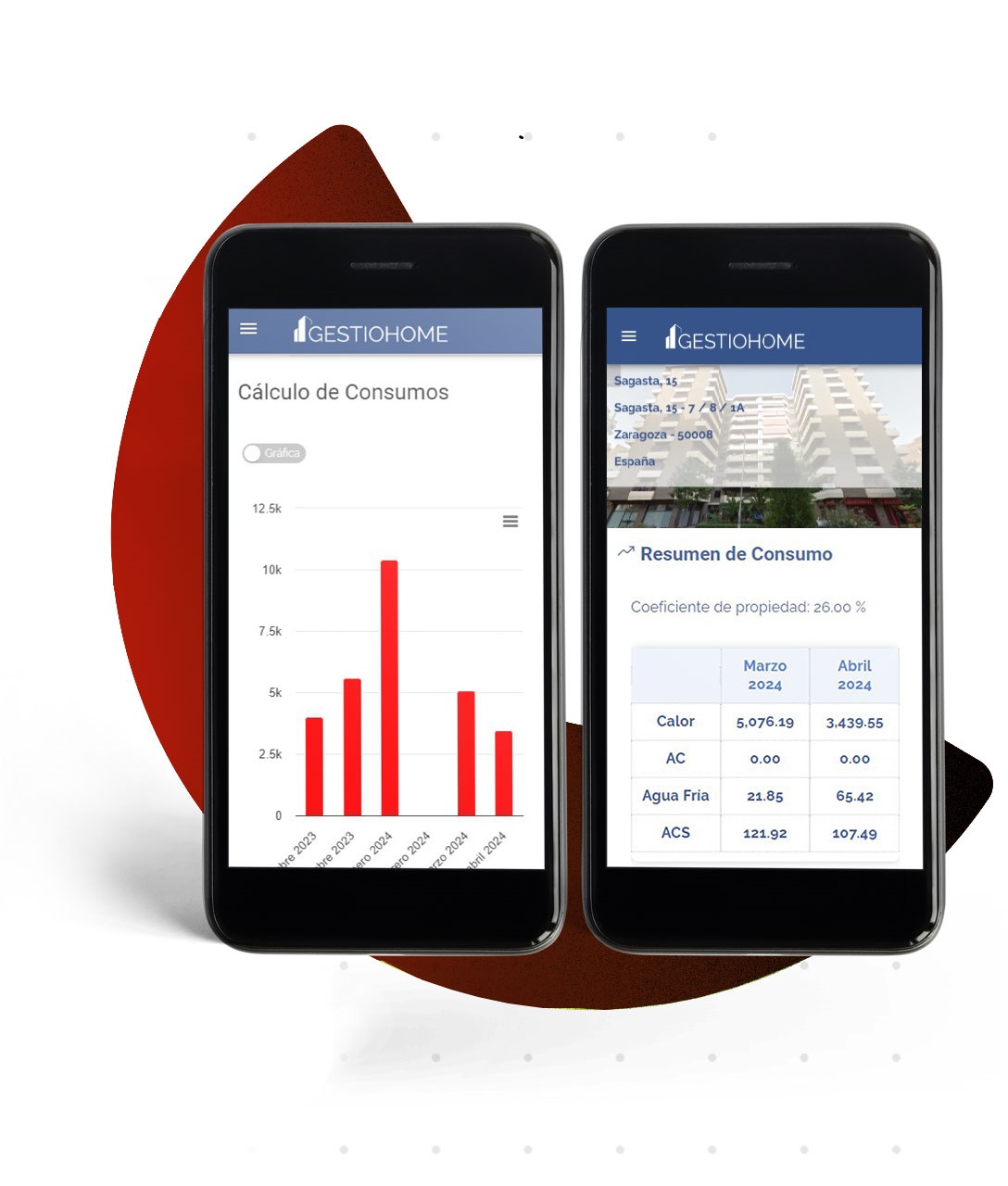
A good energy control panel is not a pretty picture full of graphs. It is a tool that allows you to do things like these:
In a community of owners
- See which buildings or portals have abnormally high consumption and check valves, insulation, or balancing.
- Detect excessive night-time consumption and adjust heating schedules.
- Generate clear consumption distribution reports to explain to residents why they pay what they pay.
In a shopping center
- Compare the consumption of common areas versus that of premises.
- Identify consumption peaks coinciding with certain time slots or events.
- Adjust lighting and air conditioning according to occupancy and actual schedule.
In an industrial plant
- Calculate consumption per production line or per batch.
- See the energy impact of shift changes, materials, or processes.
- Decide whether it is profitable to replace one piece of equipment with a more efficient one based on historical data.
In all these cases, the control panel acts as a bridge between data and decision:
“I not only know how much I consume, but where, when, and why… and, therefore, what I can do about it.”
What a good energy control panel should have
Not all panels are suitable for all profiles. A good design takes into account:
Who uses it:
- Technicians (need detail, alarms, statuses).
- Managers (need KPIs, comparisons, reports).
- End users (need clarity and transparency).
What questions should it answer at a glance:
- Am I doing better or worse than last month?
- Where do I have the greatest inefficiencies?
- Are the savings targets being met?
Some good practices:
- An initial summary with 3–5 key indicators.
- Possibility to drill down to the meter detail.
- Simple graphs, clear comparisons, and consistent unit of measurement.
- Easy export for reports, audits, or justification of aid (such as the PREE).
From data to value: the role of a platform like Usanca’s
In the case of Usanca, this entire journey is supported by a complete ecosystem:
- Hardware (control units, concentrators, repeaters, Walk-by solutions) that ensures that the data arrives complete and reliable.
- Management software (Gestio Home, Gestio Factory) that:
- Collects, organizes, and analyzes consumption.
- Generates reports and alarms.
- Offers panels adapted to administrators, managers, and users.
• Ad hoc developments and modules such as Pretel IDAE, which adapt the data to specific requirements of aid programs and regulations.
The result is not just a system that “measures”, but a tool that allows:
- Justify investments in efficiency with numbers.
- Manage communities and buildings with transparency.
- Optimize industrial processes with clear energy criteria.
- Comply with regulations and take advantage of aid without getting lost in data formats.
If you are considering implementing a complete intelligent measurement system (hardware + software + support), we can design it with you Request a consultation!
Measuring is no longer enough, you have to decide
The path from the meter to the control panel is, in reality, the path from data to decision.
Measure well.
- Collect and transmit reliably.
- Transform data into understandable information.
- Design panels that help to act.
When all this is aligned, energy ceases to be a poorly controllable cost and becomes an area where informed decisions can be made: reduce, adjust, improve, invest.
If you manage a community, a building, a network, or an industrial facility and you have data but do not feel it is useful, the next step is not to put in more meters, but to give them an outlet in a panel that speaks the language of your decisions.
You value implementing a complete intelligent measurement system (hardware + software + support)
We can design it with you. Request a consultation